ShieldBreak: When Defender Becomes the Privilege Boundary
The sequence looks like routine Windows plumbing until the timestamps are aligned: a user process registers a cloud-backed placeholder, creates private Object Manager links, asks Defender to scan a path, writes a Windows Error Reporting queue entry, then invokes QueueReporting. The last consumer runs with authority the first process did not have.
This is a composite defensive scenario derived from the public ShieldBreak proof of concept. No exploitation was performed against a Windows host in this run. The important clue is not a malware signature. It is a trusted security engine crossing a file-resolution boundary constructed by an untrusted caller.
A new CVE, not just a renamed old bug
Microsoft assigned ShieldBreak CVE-2026-69414 on August 14, 2026. The advisory classifies it as a local, low-privilege, no-user-interaction elevation of privilege in the Microsoft Malware Protection Engine, with CVSS 3.1 score 7.8. As of August 19, Microsoft marks it publicly disclosed, says exploitation has not been observed, and states that a security update is still in development. Those are the vendor’s current claims, not a guarantee that telemetry would expose private exploitation. Microsoft's live CVE record should remain the remediation source of truth.
The distinction matters because the researcher’s repository originally described ShieldBreak as a bypass for CVE-2026-50656, or RoguePlanet. RoguePlanet was a Defender elevation of privilege caused by improper link resolution before file access, cataloged as CWE-59. Microsoft released its engine fix in July. ShieldBreak reaches a similar security outcome through a different construction, so the vendor issued a separate CVE rather than revising the old one. This is the same remediation trap discussed in the FortiOS patch-bypass analysis: blocking the demonstrated path is not equivalent to restoring the violated invariant.
The public repository claims successful tests on Windows 11 25H2 Canary and Windows Server 2025. It also claims Windows 10 is vulnerable but unsupported by the released PoC. Treat the claimed 100 percent success rate as researcher-supplied test data. Microsoft has confirmed the vulnerability class and affected engine, but its advisory does not reproduce that rate or publish an affected-version matrix yet.
The confused deputy is the scanner
A malware scanner must open files that the initiating user cannot safely interpret, quarantine malicious objects, and coordinate with privileged services. That authority is intentional. ShieldBreak turns path resolution around that authority into the attack surface.
Reviewing the published C++ source reveals a chain spanning four Windows subsystems:
- Cloud Files placeholders. The process registers a sync root and creates a placeholder. Hydration lets file content and identity change at a carefully chosen point without a conventional rename being the only observable transition.
- Object Manager indirection. Private directories and symbolic links under
BaseNamedObjectscreate two interpretations of a scan path. The caller controls the namespace arrangement; the trusted consumer resolves it later. - Defender scan and remediation. The PoC loads
MpClient.dlland invokes Defender’s scan interfaces. The security engine becomes the privileged file actor rather than the exploit writing directly to a protected destination. - Windows Error Reporting. The chain stages a
Report.werentry and invokes the built-in\Microsoft\Windows\Windows Error Reporting\QueueReportingtask. A named-pipe handoff completes the transition to a SYSTEM-context consumer.
The source also uses a CLFS path, an alternate data stream, file locking, and a loopback administrative-share path. Publishing the exact object names, timing sequence, and payload construction would add reproduction value without improving the defensive argument, so they are intentionally omitted here.
The invariant is still clear: a low-integrity caller must not be able to make a privileged scanner act on a different object than the one security policy authorized. Fixes that validate only one symlink type, one namespace, or one race window leave the larger time-of-check/time-of-use problem intact.
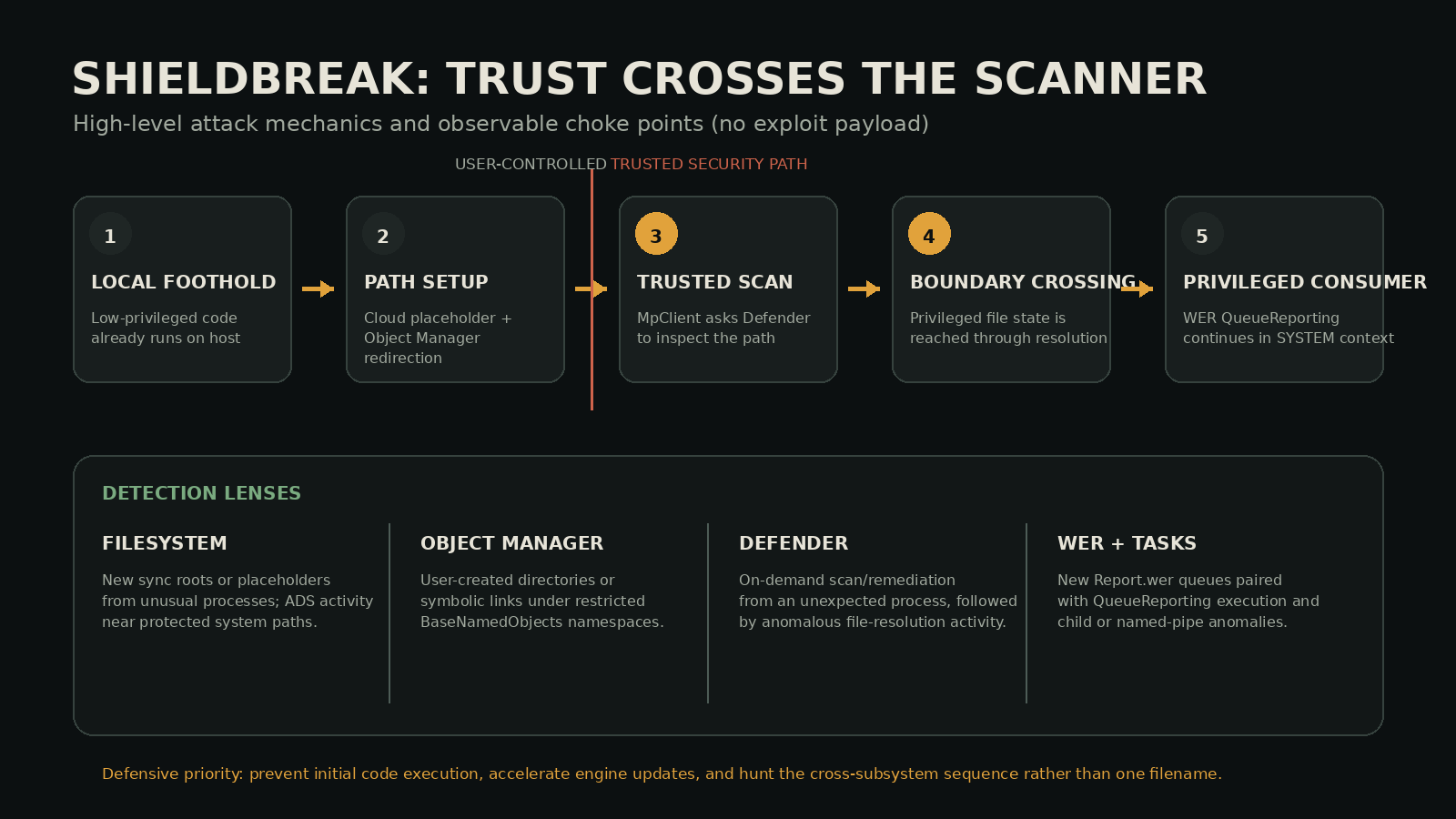
The operator’s thought process is practical. First, find a privileged component that accepts a caller-selected path. Next, identify a namespace transition where the caller can alter meaning without needing protected-directory write access. Then force the component to perform the sensitive file operation. Finally, locate a privileged consumer that will load or act on the resulting state. Each step looks ordinary in isolation. The sequence is the exploit.
Why this complements the passkey problem
Tuesday’s Pass-ta-key analysis examined valid authentication assertions emerging from a compromised endpoint. ShieldBreak sits one layer earlier in the same risk model: local code turns a trusted endpoint control into a privilege bridge, potentially gaining the authority needed to tamper with credential material, sensors, or recovery state.
Neither case breaks the advertised cryptography. Both exploit surrounding trust machinery. A passkey signature can be valid while device enrollment is hostile. A malware scan can be legitimate while the resolved object is hostile. Security architecture fails when it treats a trusted component’s output as proof that the component’s inputs and execution context were trustworthy.
Hunt the cross-subsystem sequence
Do not begin with a static filename from the PoC. The repository can change, and an operator can rename user-mode artifacts. Hunt for dependencies that are harder to remove.
The first detection surface is unusual Cloud Files activity. On endpoints that are not approved sync clients or development machines, sync-root registration and placeholder creation by unsigned binaries, newly downloaded tools, Office children, script hosts, or user-writable executables deserve investigation. Pair file telemetry with process reputation rather than alerting on every placeholder.
The second surface is namespace manipulation near a security scan. Standard EDR tables do not expose every Object Manager operation. Sysmon alone is also insufficient. High-fidelity validation may require ETW, kernel telemetry from the EDR sensor, or a targeted lab trace. Where visibility exists, correlate user-process creation of private object directories or symbolic links with MpClient.dll loading and an on-demand scan.
The third surface is Windows Error Reporting queue construction followed by task execution. Report.wer files are normal. A new queue beneath C:\ProgramData\Microsoft\Windows\WER\ReportQueue becomes more interesting when the initiating process is unrelated to a crash, the queue is followed immediately by QueueReporting, or the task produces an unexpected child, module load, or named-pipe interaction.
A Microsoft Defender XDR hunting query can establish the process and file side of that correlation. Adjust action names to the telemetry actually present in the tenant:
let window = 10m;
let werWrites = DeviceFileEvents
| where FolderPath startswith @"C:\ProgramData\Microsoft\Windows\WER\ReportQueue"
| where FileName =~ "Report.wer"
| project DeviceId, WerTime=Timestamp, InitiatingProcessFileName,
          InitiatingProcessCommandLine, FolderPath;
let taskRuns = DeviceProcessEvents
| where ProcessCommandLine has "QueueReporting"
   or (FileName =~ "schtasks.exe" and ProcessCommandLine has "Windows Error Reporting")
| project DeviceId, TaskTime=Timestamp, FileName, ProcessCommandLine,
          AccountName, InitiatingProcessFileName;
werWrites
| join kind=inner taskRuns on DeviceId
| where TaskTime between (WerTime .. WerTime + window)
| project WerTime, TaskTime, DeviceId, FolderPath,
          InitiatingProcessFileName, InitiatingProcessCommandLine,
          FileName, ProcessCommandLine, AccountName
This query is a lead generator, not a ShieldBreak signature. The DeviceFileEvents and DeviceProcessEvents schemas cover the observable edges, while Object Manager transitions may remain a sensor-specific blind spot.
For a controlled validation, use an isolated Windows VM, enable Defender Operational logging, Sysmon, Procmon backing files, and EDR collection, then perform only benign actions: register a test sync root with a signed internal harness, hydrate a harmless placeholder, request an EICAR test-file scan, create a synthetic WER report through documented test tooling, and invoke the normal reporting task. The objective is to measure which steps your stack sees, not to run the public exploit. Snapshot the VM first and keep it disconnected from production identity and management planes.
Controls while the fix is pending
There is no configuration toggle that repairs a path-confusion vulnerability inside the engine. Microsoft Defender tamper protection remains useful against settings changes, but it should not be presented as a ShieldBreak fix. The vulnerable component is being induced to act with its legitimate authority.
Until Microsoft publishes an update, reduce the prerequisite and shorten exposure:
- Prevent untrusted local execution with application control, ASR rules, attachment controls, and least privilege.
- Confirm Defender platform and engine updates are not pinned, delayed, or blocked by disconnected server workflows.
- Isolate systems where a suspicious low-privilege process is followed by WER queue manipulation or anomalous security-engine activity.
- Preserve memory, relevant ETW/EDR data, WER queues, task history, Prefetch, Amcache, and the initiating executable before remediation.
- Test detections against normal sync clients, crash-heavy applications, and developer tooling to control false positives.
The GhostApproval symlink analysis offers a useful design parallel: authorization must bind to the final object, not merely the path shown before execution. For Defender, the durable fix must make resolution and privileged action resistant to caller-controlled namespace changes across the complete operation.
Strategic takeaways
ShieldBreak is not an initial-access story. It is a post-compromise multiplier that begins after low-privileged code execution. Its value to an attacker is the conversion of an ordinary foothold into local SYSTEM authority through components defenders already trust.
The operational response should be equally precise. Track Microsoft’s CVE for the engine update. Do not equate tamper protection with remediation. Hunt the sequence across Cloud Files, Object Manager behavior, Defender scans, protected file state, WER queues, task execution, and named pipes. Most organizations will not see every link, so the immediate engineering task is to identify which link is currently dark.
The smallest detail in the chain carries the larger lesson: trusted software is not only a control. When it accepts attacker-shaped objects and resolves them with higher authority, it is also a privilege boundary.
Primary sources
- Microsoft CVE-2026-69414 advisory, published August 14, 2026
- Microsoft CVE-2026-50656 advisory, revised July 8, 2026
- MSNightmare ShieldBreak repository, created August 11, 2026
- Microsoft Defender tamper protection documentation
- Microsoft Defender XDR DeviceFileEvents schema
- Microsoft Defender XDR DeviceProcessEvents schema
💜 Enjoyed this content? Support the blog with USDT (TRC20):
TX7obcjHQbDUXb4mGqoASEu1QFTKT2CFGG