The Model Returned Python: CVE-2026-61539 and Tool-Parser RCE
The request looked ordinary: an OpenAI-compatible chat completion, a Llama-family model, and one harmless tool definition. The unusual detail was not in the request. It appeared after inference, when the model returned something that resembled a Python dictionary.
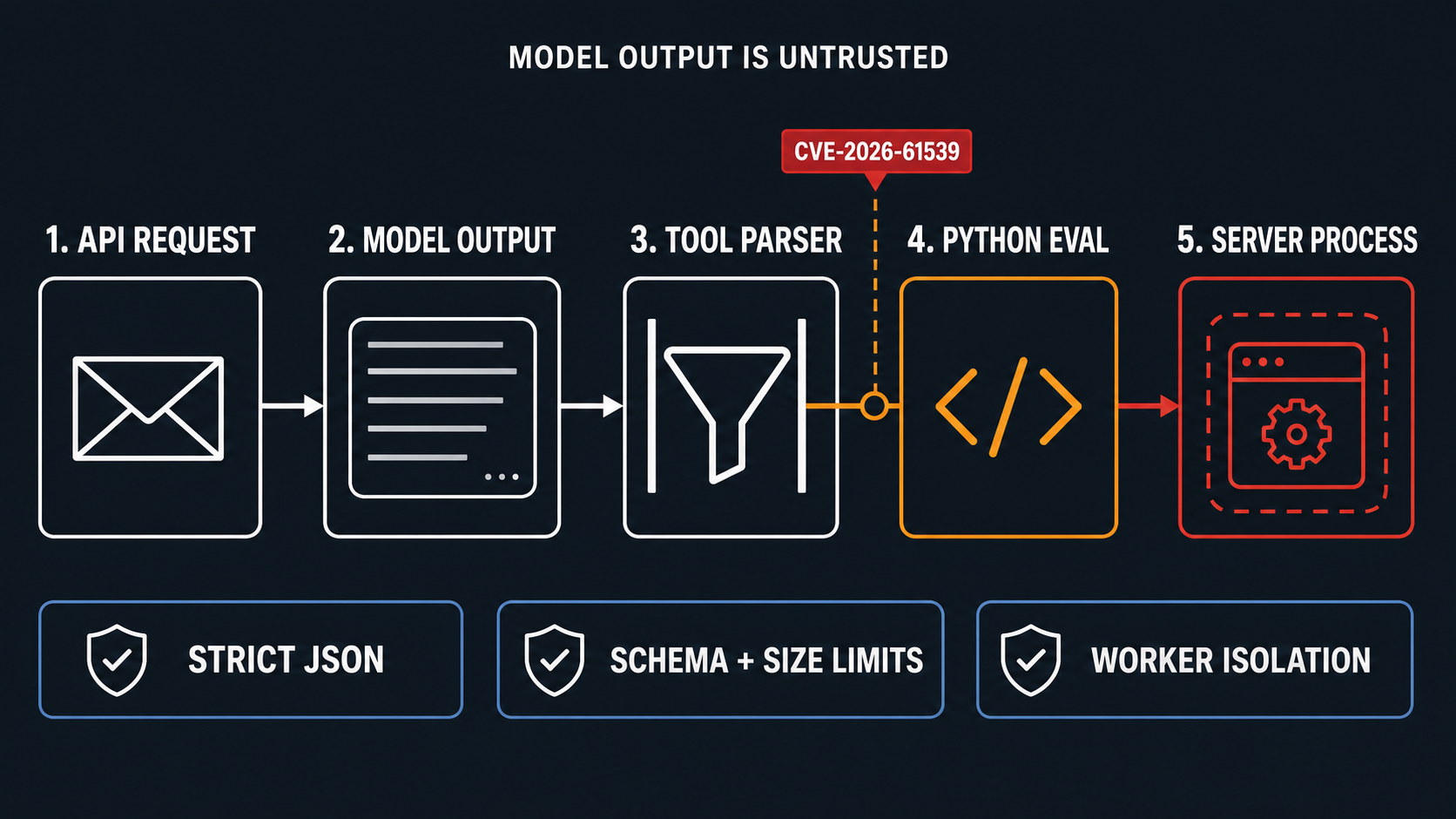
In the vulnerable path, that string did not remain model output. Xinference handed it to Python’s eval().
That boundary error is CVE-2026-61539, a critical RCE in Xinference versions through 2.5.0. The vendor advisory was published on July 13, 2026, and the GitHub Advisory Database entry surfaced on August 21. The fix is in 2.7.0.[1][3] The issue is worth studying beyond one product because it exposes a recurring failure in AI infrastructure: developers treat structured model output as if it came from a parser, when it still comes from an attacker-influenced generator.
The parser became the execution engine
The vulnerable Llama3 tool-call parser was compact:
def extract_tool_calls(model_output):
    try:
        data = eval(model_output, {}, {})
        return [(None, data["name"], data["parameters"])]
    except Exception:
        return [(model_output, None, None)]
The intention is obvious. Llama-family tool output often looks like a Python dictionary rather than strict JSON. Evaluating the string appears to recover name and parameters with minimal compatibility code.
The problem is equally precise. eval() evaluates a Python expression. Empty global and local dictionaries are not a sandbox. Python inserts a reference to builtins into the globals dictionary when __builtins__ is absent, which leaves import and other powerful primitives reachable.[4] MITRE classifies this failure as CWE-95, dynamically evaluated code that does not neutralize directives.[6]
The vendor’s data flow shows why this became remotely relevant. A non-streaming /v1/chat/completions request reaches the model’s chat() path. With the Transformers backend and a tools field present, Xinference post-processes the completion. The Llama3 parser then evaluates the model’s text in the server process.[1]
That creates a trust chain with four distinct control transitions:
- Attacker-controlled prompt enters a chat endpoint.
- The model transforms that prompt into tool-call-shaped text.
- The application mistakes generated text for trusted structure.
- Python interprets the text as executable syntax.
The model is not the code-execution primitive. It is the delivery transducer. eval() is the primitive.
Why “the model may refuse” is not a control
An operator testing this path first asks whether output control is reliable enough to reach the parser. That is the uncertain stage. Model family, system prompt, sampling, chat template, quantization, and safety tuning can all alter the completion. A payload that works once may be reformatted, quoted, or rejected on the next request.
None of that repairs the vulnerability. Reliability changes exploitability, not the trust violation. A determined attacker can iterate across prompts and parameters. An indirect attacker may also influence content that an application places in the prompt, such as retrieved documents, tickets, repository text, or web pages. The attack therefore sits at the intersection of prompt injection and ordinary interpreter injection.
The tools field matters too. It is not merely metadata for the client. In this flow, its presence selects post-processing that reaches the vulnerable parser. Defenders should not reduce the hunt to suspicious strings in user messages. The higher-value signal is the combination of a tool-enabled, non-streaming request and anomalous model output immediately before parser handling.
Authentication changes exposure but not impact. The advisory reports an unauthenticated tested deployment.[1] Current Xinference documentation says the newer database-backed authentication system, introduced in version 3.0, is enabled by default. It also documents an environment switch that can disable authentication entirely.[7] An older affected deployment, an intentionally unauthenticated internal service, or a compromised API credential can still put attacker-controlled prompts on the path.
A safe mechanism lab
I reproduced the disclosed parser primitive locally without running Xinference, opening a listener, or contacting a remote service. The lab used a temporary directory and an expression that could only write a sentinel file inside it:
import ast, json, tempfile
from pathlib import Path

with tempfile.TemporaryDirectory() as td:
    marker = Path(td) / "parser-eval-sentinel"
    expression = (
        "__import__('pathlib').Path("
        + repr(str(marker))
        + ").write_text('lab-only')"
    )

    eval(expression, {}, {})
    assert marker.read_text() == "lab-only"

    marker.unlink()
    try:
        json.loads(expression)
    except json.JSONDecodeError:
        try:
            ast.literal_eval(expression)
        except (ValueError, SyntaxError):
            pass

    assert not marker.exists()
The vulnerable branch created the sentinel and returned the number of bytes written. The patched strategy rejected the expression, created no file, and still accepted both strict JSON and Python literal dictionaries. This is a reduced, non-vendor-specific mechanism test, not a claim that a particular deployed model will emit an arbitrary expression on demand.
The distinction matters for ethical testing. A useful validation plan separates two questions: can the model be induced to produce parser-breaking output, and can the parser execute that output? The local lab answers the second without weaponizing a live service. Testing the first belongs only in an isolated, authorized deployment with egress blocked and disposable credentials.
The patch fixes execution, not every parser risk
The patch replaced both vulnerable eval() call sites with a two-stage parser. It tries json.loads() first, then falls back to ast.literal_eval() for outputs containing Python values such as True, False, and None. Expressions involving imports, function calls, lambdas, or class traversal are rejected. The commit also added regression tests for command execution, nested evaluation, malformed objects, missing keys, and non-dictionary JSON.[2]
That is the correct compatibility direction, but ast.literal_eval() is not a general untrusted-input firewall. Python’s documentation warns that a relatively small input can cause memory exhaustion, C stack exhaustion, or excessive CPU use.[5] The RCE is removed, while parser-level availability risk still deserves explicit limits.
A stronger boundary validates more than syntax:
MAX_TOOL_OUTPUT = 32_768

if len(model_output) > MAX_TOOL_OUTPUT:
    raise ValueError("tool output too large")

data = json.loads(model_output)
if not isinstance(data, dict):
    raise TypeError("tool call must be an object")
if set(data) != {"name", "parameters"}:
    raise ValueError("unexpected tool-call fields")
if not isinstance(data["name"], str):
    raise TypeError("tool name must be a string")
if not isinstance(data["parameters"], dict):
    raise TypeError("parameters must be an object")
Strict JSON is preferable when the model template can produce it consistently. Where compatibility requires Python literals, bound input length before parsing, catch resource-related exceptions, validate the resulting type and schema, and isolate inference workers with filesystem, credential, and egress restrictions.
Reconstructing the attack chain
For a Red Team, the realistic chain is not “send shellcode to the model.” It is a sequence of hypothesis tests.
First, identify an OpenAI-compatible endpoint and infer whether tool calling is supported. Version responses, model metadata, client error formats, or internal application behavior may reveal Xinference, but do not assume the parser from the API shape alone.
Second, determine whether the request can select a Llama3 tool parser, a Transformers execution path, non-streaming behavior, and tool post-processing. The advisory names these conditions; other backends and parsers should not be declared vulnerable without evidence.[1]
Third, test output-shape influence with inert canaries. A safe canary is a syntactically invalid tool call containing a unique random marker, not an operating-system command. Observe whether the application returns the text, rejects it, or logs a parser exception. Stop if the environment is not isolated.
Finally, in a disposable lab, confirm the parser primitive with a sentinel constrained to a temporary directory. The operator should treat model nondeterminism as an experimental variable and record model, template, temperature, seed support, backend, streaming mode, and exact tool schema.
This approach aligns with a broader AI attack-chain model: prompt influence becomes dangerous when another component grants it authority. It also reinforces the trust-boundary approach to AI threat modeling. Model output is a separate trust zone, even when the model runs locally.
Detection that survives payload changes
Payload signatures are fragile because the model may change quoting, whitespace, or syntax. Detection should bind API, inference, parser, and host telemetry.
At the API layer, retain request IDs, authenticated principal, source address, model, backend, stream, whether tools was present, tool names, prompt and completion sizes, latency, and parser outcome. Avoid logging raw prompts by default when they may contain secrets. A keyed hash or protected, short-retention capture can support investigations without turning logs into a second data leak.
At the parser layer, alert on repeated parse failures after tool-enabled completions, completions that begin with expression-oriented tokens, and outputs that are neither objects nor expected tool names. Instrument the transition into post-processing rather than relying only on reverse-proxy access logs.
At the host layer, correlate the same request ID with child-process creation, shell execution, writes outside model-cache and application directories, reads of service-account tokens, and new outbound connections. The cleanest policy is architectural: an inference worker should have no reason to spawn a shell, reach cloud metadata, read deployment secrets, or write broadly across the host.
For exposure management, inventory xinference versions and deployment modes. Upgrade affected versions through 2.5.0 to 2.7.0 or later.[1][3] Confirm the running artifact, not only a lockfile. Then review authentication and network reachability, rotate credentials if compromise is plausible, and hunt backward from inference-worker process telemetry.
Relevant internal controls overlap with MCP tool security and the capability analysis in GitLost: the decisive question is not whether untrusted text exists. It is which interpreter, tool, credential, or filesystem boundary consumes it next.
Strategic takeaways
CVE-2026-61539 is a short patch with a large lesson. AI infrastructure accumulates adapters that normalize unstable model dialects. Those adapters are security-critical parsers, even when they look like glue code.
Treat every completion as hostile serialization. Prefer strict formats, enforce size and schema before use, remove interpreter semantics, and give the inference worker fewer capabilities than the application calling it. Prompt filtering can reduce noise. It cannot make eval() safe.
The request was only text. The server supplied the authority.
Sources
[1] Xinference security advisory GHSA-x2rj-828p-hx9m, published July 13, 2026. [2] Xinference patch commit 1b3d220, April 14, 2026. [3] Xinference v2.7.0 release, April 25, 2026. [4] Python documentation: 0. [5] Python documentation: 1. [6] MITRE CWE-95. [7] Xinference authentication documentation.
💜 Enjoyed this content? Support the blog with USDT (TRC20):
TX7obcjHQbDUXb4mGqoASEu1QFTKT2CFGG