The Console Said Run: Able2Shell and the Trust That Outlived the Patch
A maintenance window closed at 06:40 with the build string 2026.4.1.26 on screen. The N-central server had been offline during the upgrade, agents were updated before probes, and the Legacy API toggle read off. Four days later, a workstation in a client’s finance OU executed a command that no interactive user typed, under NT AUTHORITY\SYSTEM, with the agent’s own service as the parent process.
The sequence is composed. The mechanism is not.
Able2Shell is worth studying because it separates two questions that patching tends to merge: which code paths were closed, and who is still allowed to ask an agent to run something. The vendor answered the first within forty-eight hours. The second is a property of the architecture, and no hotfix rewrites it.[1]
What was published, and in what order
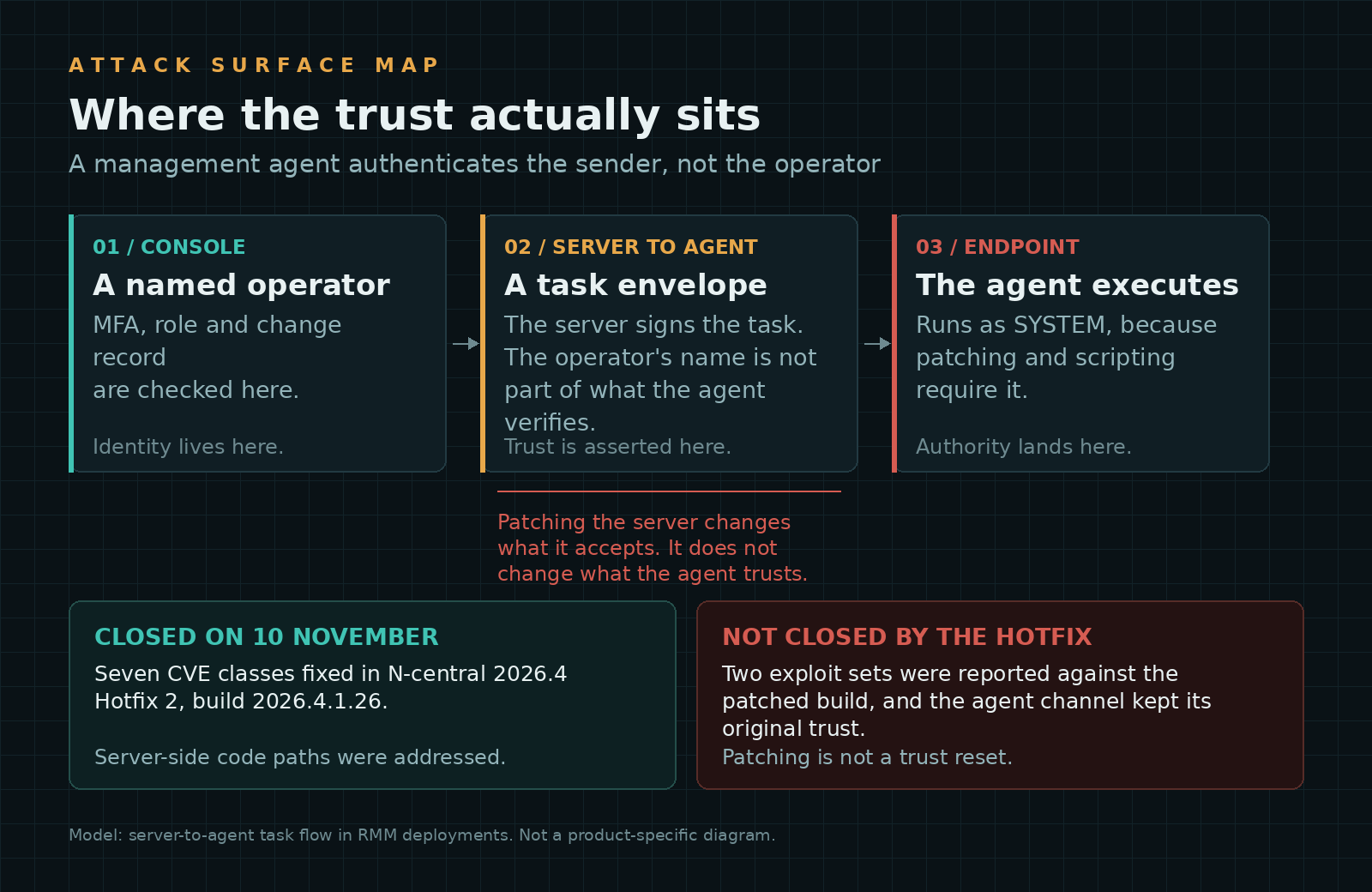
On November 8, 2026, an independent researcher published 33 alleged vulnerabilities in N-able N-central, packaged with proof-of-concept code and organized into four exploit chains. N-able took hosted environments offline across the Americas, Europe and APAC on November 9 and told on-premises customers to do the same. Hotfix 2, build 2026.4.1.26, arrived on November 10 with seven CVE records attached.[1][2][3]
Seven records for thirty-three bugs is a mapping decision, not a coverage statement. N-able grouped the fixes by vulnerability class: XML external entity handling, OGNL injection, a syslog-ng configuration that the service account could write, stored XSS in patch metadata, schema-hint SSRF, upload path traversal, and insecure IPC.[6][7][8][9][10] If your evidence of remediation is a CVE count, you do not yet know what you closed.
On November 11 the same researcher published two more exploit sets, 4EverAble2Shell and Agent2Shell, reported to work against the hotfixed build. No CVEs were assigned at the time of writing. N-able said it was assessing the new disclosure and had no evidence of successful exploitation.[1][4][13]
Chains that end on the server, and one that does not
The server-side chains share a shape. An unauthenticated XML external entity flaw in the service-import function allowed an attacker to make the appliance fetch and parse attacker-controlled XML, read local files, and recover a trusted local session. With that session, the researcher’s code reset an account password, executed commands as the nable service user, and created an enabled “Default Administrator” account. A stored XSS in patch metadata reached the same account context when an administrator opened the poisoned patch, and the same session could drive an Audit Export command to root. A path traversal in the SIS component produced code execution as nable, then a syslog helper wired to a configuration the service account could write turned that into root.[1][6][9]
Two details matter more than the chain count. First, the base score on the XXE record is 9.3 with no privileges and no user interaction, which describes the entry point accurately but not the blast radius: the value of that primitive is the session it yields, and the session is what reaches the task engine.[6] Second, 4EverAble2Shell reportedly reaches root without credentials by chaining an Apache Axis 1.x SOAP fault deserialization issue, CVE-2026-90436, into an N-central privilege escalation. Axis 1.x is end-of-life, and its presence is a design tell for how much legacy surface remains behind the modern console.[1][11]
The dependency that decides exposure is configuration, not version. N-able linked the server chain to the Legacy API being enabled and reachable from the internet. An HF2 server with that interface disabled was not exposed to that specific chain. Agent2Shell is the part that does not follow this pattern cleanly: it targets more than ten issues in how the server talks to agents and probes, and two of its chains let an unauthenticated attacker who can reach the server run commands as SYSTEM on managed Windows endpoints. The attacker needs the target appliance ID, which is an identifier, not a secret.[1][13]
The channel is the asset
An RMM server is not a console that happens to have agents. It is a command broker with a fleet of privileged local proxies that persist, check in over outbound HTTPS, execute scripts, deploy patches and, in most deployments, can open a remote-control session. The agent usually runs as SYSTEM on Windows and as root elsewhere, because patch deployment and script execution require it.
That design answers a question the operator rarely asks: when an agent receives a task, what does it authorize? In most implementations it authorizes the sender. It verifies that the message came from its enrolled server, then executes. The human identity in the console is asserted by the server, not carried in the command as something the endpoint can independently check. The trust direction is one-way, and that is exactly what makes the server such a valuable intermediate target.
This is why a server-side file read deserves a second look. The file is not the objective; the session state it exposes is, and that session reaches the task queue. Patch the XXE and you close one entrance to the broker. You have not changed the fact that anything reaching the broker’s task interface speaks with the broker’s authority to every endpoint it manages. The PHP2Shell request-lifecycle analysis asked the same question one layer down: not what crashed, but which state survived it.
A bounded check of the trust direction
To make the distinction concrete without reproducing vendor behavior, I built a loopback model: a small agent process that accepts a JSON task over 127.0.0.1, restricted to three read-only commands. One endpoint trusts whoever connects. The other requires an HMAC over the message body plus timestamp, with a nonce cache. The forged envelope is identical in both cases.
unsigned envelope -> agent trusts the sender     HTTP 200  {"executed": true, "stdout": "root"}
unsigned envelope -> agent verifies HMAC        HTTP 401  {"executed": false, "error": "signature mismatch"}
signed envelope, first use                       HTTP 200  {"executed": true, "stdout": "root"}
signed envelope, replayed nonce                  HTTP 409  {"executed": false, "error": "nonce already used"}
The first line is the whole problem in one request. The naive agent did not misconfigure anything; it implemented the trust model it was given. The second agent is safer because the envelope carries something a confused or compromised upstream cannot mint on demand, and because reuse is refused. N-central’s protocol is proprietary and this model says nothing about its internals. What it shows is the property to ask about: can the endpoint distinguish a task issued by an operator from a task issued by anything that reached the server?
Detection sits on both sides of the link
Most RMM incident response fails at scoping, not at log collection. Teams examine the server, find a web shell or a new administrator, clean it, and restore service, while the endpoints that received tasks during the exposure window are never enumerated. Build the query in the other direction: start from what the agents executed.
On the server, the useful evidence is narrow. HTTP access logs showing XML bodies posted to service-import and schema-validation endpoints from unexpected sources. New children of the application service account, particularly shells and download utilities. A newly enabled administrator, a password reset on an existing one, or an account named like a vendor default. File integrity on the syslog-ng configuration, deployed web applications, and the file repository. Outbound curl or wget fetching a script is worth an alert on its own; reporting on the attempted chain describes exactly that step.[1]
On the endpoint, the agent’s own process tree is the pivot. A script interpreter started by the agent service outside a maintenance window, a new Windows service, a new scheduled task, a new local administrator, or a remote-control session with no matching ticket all point at the same possibility. The August 2026 N-central incident left a template for what persistence looks like after the console is lost: the actor used the built-in remote-control feature to reach managed devices and registered Cloudflare tunnel services on them so access survived the revocation of the console account. N-able’s indicators included a registered service named “Cloudflared”, unusual remote-control activity and suspicious console logins.[5][12]
A starting query, with process names replaced by whatever the deployment actually uses:
DeviceProcessEvents
| where InitiatingProcessFileName startswith "N-able" or InitiatingProcessParentFileName startswith "N-able"
| where FileName in~ ("cmd.exe", "powershell.exe", "curl.exe", "wget.exe", "net.exe")
| project Timestamp, DeviceName, AccountName, InitiatingProcessFileName, FileName, ProcessCommandLine
| order by Timestamp desc
Two network checks complete the picture. Probes relay tasks into segments the server cannot reach directly, so a probe that re-registers, changes address, or starts issuing tasks outside its normal schedule is a scoping signal. And because the agent dials out, egress filtering on the management VLAN is one of the few controls that survives a server compromise: if the server cannot reach arbitrary hosts, it cannot fetch a second-stage script or register a tunnel.
What to change before the next disclosure
Treat the RMM server as Tier 0, next to the domain controller and the certificate authority. That classification has consequences: no direct internet exposure, access through a VPN or zero-trust proxy with an allowlist, MFA on every console account, and change control that covers plugin and integration enablement, not just the core build. N-central’s own history supports the comparison; the AD CS containment problem and the RMM containment problem are the same problem, an administrative object whose compromise outlives the credential that was used to reach it.[5]
Disable the Legacy API and any integration you are not actively using. In this disclosure that toggle decides whether an unauthenticated root chain is reachable at all, and the Axis 1.x dependency behind the second exploit set is a reminder that legacy interfaces do not age out of the attack surface just because the console looks modern.[1][11] Patch agents and probes as a separate track from the server, and verify the agent version across the fleet rather than only the build string on the appliance. The handoff is where trust quietly accumulates, a lesson that the GitHub Actions TOCTOU case made the same way: the approving system and the executing system saw different objects.
Finally, plan the trust reset. Patching closes code paths. It does not revoke the enrollment the agent already holds. If a server was exposed, or if exposure cannot be excluded, re-enroll agents and rotate enrollment material, the same way you would reissue certificates after a CA compromise. Otherwise the hotfix restores the console to a clean state while the fleet continues to trust whatever answers on the other end of the channel.
Strategic takeaways
Patch velocity and trust repair are different metrics. N-able moved from disclosure to hotfix in two days, and a second exploit set still landed against that hotfix. The measurable question is not how fast the vendor shipped, it is whether your exposure depended on a configuration you had already disabled.
For an MSP, the RMM server is the highest-leverage host in the estate. It holds a privileged channel into every client it manages, which makes it a supply-chain amplifier rather than a management convenience. Budget for its isolation, monitoring and recovery the way you budget for identity infrastructure.
Where a vendor publishes a CVE count, ask for the chain. The number tells you how the fixes were grouped. The chain tells you what an attacker needed, what the endpoint would have executed, and which of your controls would have produced evidence. That is the difference between a patch record and a defensible position, and it is the same discipline behind a VEX-based exploitability decision. It is also the part of this story that will still be true after the next hotfix.
Sources
- Kudelski Security: N-able N-central “Able2Shell” 0-day vulnerabilities
- Rapid7: Critical vulnerabilities in N-able N-central
- N-able status: N-central critical security incident (event 202584)
- N-able status: follow-up disclosure (event 202613)
- N-able: N-central security update, August 10, 2026
- CVE-2026-125883: multiple XXE vulnerabilities in N-central
- CVE-2026-125881: schema-hint SSRF in N-central
- CVE-2026-125879: local privilege escalation via syslog-ng configuration
- CVE-2026-125882: RCE via file repository path traversal
- CVE-2026-91000: insecure IPC channels in N-central
- CVE-2026-90436: Apache Axis 1.x SOAP fault class instantiation
- CVE-2026-18577: incomplete patch leading to N-central account takeover
- Huntress: N-able disables cloud services after Able2Shell disclosure
- runZero: finding N-able N-central installations on the network
Analysis reflects vendor advisories, CVE records and third-party reporting available on November 16, 2026. The loopback model was built and executed for this article; it is not a reproduction of N-central internals. The opening scenario is composed and labeled as such.
💜 Enjoyed this content? Support the blog with USDT (TRC20):
TX7obcjHQbDUXb4mGqoASEu1QFTKT2CFGG