The 5 Highest-Paying Bug Bounty Vulnerabilities
Bug bounty does not reward “beautiful technique”; it rewards demonstrable impact. Two findings may look similar in a report, yet have completely different value when one of them crosses the boundary between “unexpected behavior” and “business risk”: code execution, account takeover, unauthorized data access, internal file reads, or database compromise.
This article organizes the five classes that, in practice, tend to generate the highest rewards when they appear with solid proof of impact. The goal is not to turn this into a payload list for real targets, but into a mental map for researchers who want to move beyond superficial bugs and write reports with well-grounded evidence, scope, and severity.
How to think about “highest paying”
The value of a bounty rarely depends only on the vulnerability name. Mature programs pay for a combination of:
- Control obtained: read, write, execution, permission change, or persistence.
- Data affected: personal, financial, source code, secrets, tokens, or internal documents.
- Reach: one user, all users, corporate tenants, admins, or internal environment.
- Exploitability: pre-auth vs. post-auth, low interaction vs. complex interaction, repeatability.
- Proof quality: clean evidence, demonstrated impact without damage, logs, and reproducible steps.
That is why a stored XSS in a low-privilege field may pay little, while a stored XSS in an administrative panel with session theft or privileged action can become critical. The same applies to IDOR: changing an ID and seeing an irrelevant field is very different from downloading invoices, changing roles, or accessing third-party documents.
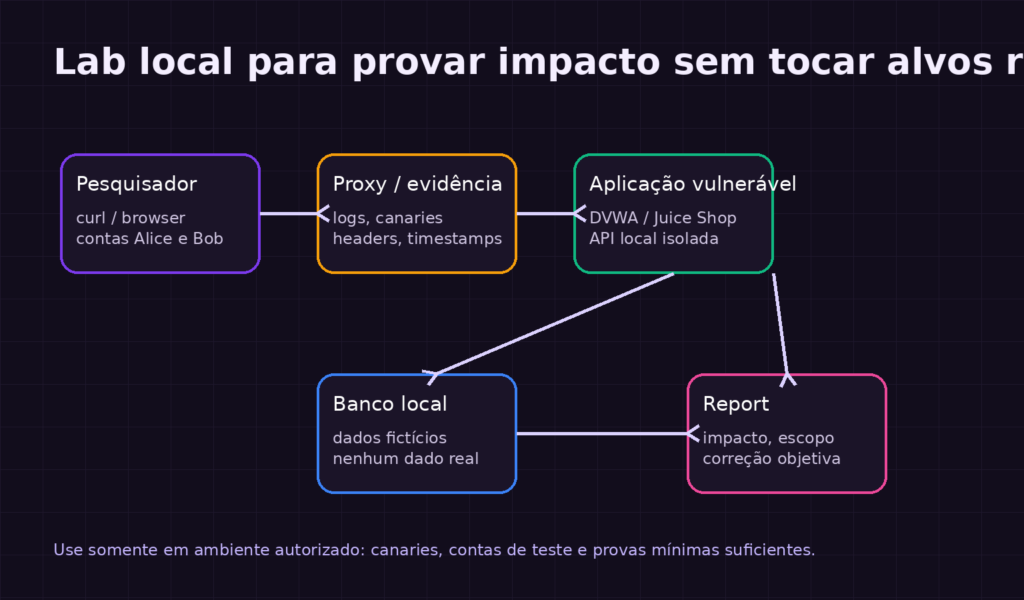
Local lab used in the examples
The examples below are intentionally described as local labs. Do not test outside scope and do not use payloads against real systems without formal authorization. A simple environment to train impact reasoning can have three components:
services:
  app:
    image: vulnerables/web-dvwa
    ports:
      - "8080:80"
  juice-shop:
    image: bkimminich/juice-shop
    ports:
      - "3000:3000"
  db:
    image: mysql:8
    environment:
      MYSQL_ROOT_PASSWORD: lab-only-password
      MYSQL_DATABASE: bounty_lab
The goal of the lab is not to copy payloads, but to practice what a good report must answer: which trust boundary was broken, which data or action was reached, what was the prerequisite, and how should it be fixed?
1. RCE and Command Injection
Why it pays highly: server-side code execution usually turns an application flaw into environment compromise risk. Even when the process runs with limited privileges, the impact may include access to files, tokens, environment variables, internal network, and lateral movement.
In bug bounty, RCE often appears in places that receive files, URLs, templates, packages, or parameters passed to system tools: importers, image/PDF converters, Git integrations, CI/CD pipelines, file parsers, and forgotten debugging routines.
Safe example in the lab
Imagine a local function that accepts a hostname for diagnostics and executes a system utility. In a lab, proper validation means proving that untrusted input crosses the application → shell boundary. An advanced report does not need to destroy anything: it is enough to demonstrate controlled execution with a harmless marker, record the process user, current directory, and non-sensitive variables.
# local lab: safe and non-destructive evidence
curl 'http://127.0.0.1:8080/debug/ping?host=127.0.0.1'

# expected report evidence:
# - user-controlled parameter reaches execution on the server
# - process runs as www-data/node/appuser
# - impact: command execution in the application context
# - fix: do not invoke a shell; use an allowlist and native APIs
How to improve the report: show input origin, dangerous sink, process privilege, container boundary, and mitigation path. An RCE with clean evidence is usually valued much more than a noisy screenshot with no operational context.
2. Account Takeover and authentication bypass
Why it pays highly: account takeover is direct impact. If an attacker can assume another account without victim interaction, bypass MFA, abuse password reset, or swap identity in OAuth/SAML, the risk is clear to product, legal, and business teams.
The best findings in this class usually happen in edge flows: user invitation, email change, password recovery, magic links, social login integration, mobile authentication, tenant switching, OAuth callbacks, and legacy endpoints that do not pass through the same middleware as the main login flow.
Safe example in the lab
In the lab, create two accounts: [email protected] and [email protected]. The defensive test is to observe whether recovery tokens, magic links, or OTP codes are bound to the correct user, expire quickly, and cannot be reused in another context.
# validation checklist in the lab
# 1. Does the reset token expire after use?
# 2. Is the token bound to the user and purpose?
# 3. Does email change require reauthentication?
# 4. Does the OAuth callback validate state, nonce, redirect_uri, and issuer?
# 5. Is MFA required for sensitive actions, not only at login?
How to improve the report: avoid generic phrases such as “I can access the account.” Document the chain: precondition, endpoint, validation flaw, victim test account, result, and realistic impact. If it involves OAuth/SAML, include a diagram of expected flow versus broken flow.
3. Access Control, IDOR, and Privilege Escalation
Why it pays highly: broken access control is one of the most common and also one of the most underestimated classes. The value rises when the flaw moves beyond “seeing some random data” and reaches third-party resource read/write, role changes, administrative actions, or tenant-isolation failures.
In modern applications, IDOR is rarely just changing /users/123 to /users/124. It appears in GraphQL, mobile APIs, asynchronous exports, webhooks, attachments, S3 objects, internal IDs exposed in the frontend, and processing queues.
Safe example in the lab
# local lab with two sessions: Alice and Bob
# Alice creates a report: report_id=101
# Bob tries to access the same object using his own session
curl -H 'Cookie: session=bob_lab_session' \
  'http://127.0.0.1:3000/api/reports/101'

# a good report does not stop at HTTP 200:
# - identifies expected ownership
# - shows that Bob reads/changes Alice's resource
# - measures whether one object or all objects are affected
# - suggests server-side checks by owner/tenant/role
How to improve the report: use an authorization matrix. List actor, resource, expected action, obtained action, and impact. That transforms a “simple” IDOR into evidence of a systemic authorization failure.
4. Arbitrary File Read, Path Traversal, and XXE
Why it pays highly: arbitrary file read may seem less dramatic than RCE, but in real environments it often exposes .env, cloud keys, CI/CD tokens, database credentials, certificates, backups, or source code. In many chains, file read is the first step toward critical impact.
This class appears in attachment downloads, PDF viewers, export endpoints, archivers, XML importers, template renderers, accessible logs, and functions that build file paths from user input.
Safe example in the lab
# Instead of targeting real sensitive files, create a canary in the lab:
echo 'BUG_BOUNTY_LAB_CANARY=ok' > /tmp/bounty-lab-canary.txt

# The report should prove unauthorized reading of a controlled file,
# then explain why, in production, the same bug could reach
# configs, tokens, or internal files.
How to improve the report: show missing path normalization, filter bypass, expected sandbox root, and root actually reached. For XXE, highlight whether there is external-entity resolution, local file access, or internal network calls.
5. SQL Injection and critical data injections
Why it pays highly: SQL Injection is old, but it remains extremely relevant when it allows data extraction, alteration, or destruction. The reward rises when the flaw affects authenticated endpoints with real data, internal panels, complex filters, reports, or APIs used by enterprise customers.
Beyond classic SQL, it is worth thinking about NoSQL Injection, LDAP Injection, misuse of query builders, and dynamic filters that accept operators directly from the client.
Safe example in the lab
# defensive approach in the lab:
# - confirm behavior difference between normal input and special input
# - avoid mass dumping
# - prove impact with a controlled canary table
# - record the vulnerable query and fix with prepared statements
How to improve the report: do not perform unnecessary dumping. Prove the vulnerability with the smallest possible data volume, explain the injection type, affected parameter, read/write capability, and expected fix: parameterized queries, type validation, and removal of client-controlled operators.
Honorable mentions: SSRF and Stored XSS
SSRF can be medium or critical depending on the reachable destination. An SSRF that only makes a request to an attacker-controlled external domain is one thing; an SSRF that reaches cloud metadata, internal services, administrative panels, or orchestration endpoints is something else entirely.
Stored XSS also varies widely. Stored XSS in a public profile may have moderate reward; stored XSS in a support panel, admin area, markdown renderer, ticketing system, or supply chain path can escalate into session hijacking, privileged action, and broad impact.
Framework for writing reports with higher reward potential
- Context: explain the surface, the user role, and the affected asset.
- Broken boundary: authentication, authorization, tenant isolation, sandbox, parser, shell, database, or internal network.
- Minimum proven impact: demonstrate with a test account, canary, or controlled data.
- Realistic impact: explain what would happen in production without extrapolating beyond the evidence.
- Clean reproduction: short steps, required headers, environment, preconditions, and expected result.
- Objective remediation: do not just say “validate input”; indicate the architecture change or specific control.
Quick checklist to prioritize hunting
- Look for flows that transform input into execution: importers, webhooks, converters, templates, and asynchronous jobs.
- Test server-side authorization in APIs, exports, attachments, GraphQL, and indirect objects.
- Review identity flows: password reset, email change, invitation, SSO, OAuth, SAML, and MFA.
- Analyze endpoints that read files, download documents, or process XML/ZIP/PDF.
- For SQLi/NoSQLi, prove impact with a canary and the smallest possible data exposure.
FAQ
Does XSS still pay well in bug bounty?
Yes, but it depends on context. Common reflected XSS tends to pay less. Stored XSS in a privileged panel, support flow, admin area, markdown renderer, or supply chain flow can have high impact.
Is a simple IDOR enough for a high reward?
Usually not. The value rises when the IDOR demonstrates access to sensitive data, resource modification, tenant breakout, privilege escalation, or impact on many users.
Should I include full payloads in the report?
Include what is necessary for authorized reproduction, but avoid damage, mass dumping, or destructive commands. Use canaries, test accounts, and the minimum evidence required.
What most increases the value of a bounty?
Impact clarity. Reports with scope, precondition, minimum evidence, business risk, and objective remediation tend to be evaluated better than long reports full of technical noise.
Recommended references
- OWASP Top 10
- OWASP API Security Top 10
- PortSwigger Web Security Academy
- HackerOne — Severity Guidance
In the end, the logic is simple: bug bounty pays better when the vulnerability stops being a technical curiosity and becomes objective proof of impact.
💜 Enjoyed this content? Support the blog with USDT (TRC20):
TX7obcjHQbDUXb4mGqoASEu1QFTKT2CFGG