An AI Agent Approval Is Only as Good as Its Receipt
The approval log has one entry. The receiver has two. In this hypothetical incident, a reviewer approved one update to a test ticket. The worker timed out, resumed its run, and sent the update again. The label on the ticket looks right. Only the receiver’s change history shows that the update fired two downstream notifications. The reviewer did nothing wrong, and the model didn’t have to disobey anyone.
Start with the second write. Did it carry the same request key and the same arguments? If so, look for missing deduplication or a retry sent outside the receiver’s retention window. If the key stayed the same but the arguments changed, look at what the worker reconstructed from the checkpoint. If the key changed, find the code that minted a new execution identity for what was supposed to be the same operation. The answers point to three different fixes. A screenshot of the approval prompt settles none of them.
Follow the decision to the effect
A November 14, 2026 preprint by Deng and colleagues separates two obligations: stop denied effects, and finish eligible approved work within an explicit horizon. Among 300 approvals in one model panel, seven did not complete, even though that panel recorded no denied effects. In a separate experiment, four of 59 comparable n8n workflows executed after rejection. These are results from the authors’ test setups, not estimates of production prevalence. The useful idea is the test design: hold the upstream state and operation fixed, vary the decision, and check what the destination actually recorded.
For an agentic workflow, the chain to audit is proposal → approval → dispatch → effect. A tool call may be perfectly valid at the first two steps and still reach the wrong destination later. Untrusted content can influence the proposal; a resumed worker can reload a mutable reference; the downstream service can accept a valid request twice. These are different failures. A hardened prompt can help with the first and still do nothing about the other two. This site has covered the input side in GitLost and the public-issue/private-repo boundary. The focus here is the state that survives after a decision has already been made.
Freeze what the reviewer saw
Store an immutable, versioned description of the action before approval. Give it stable identifiers for tenant, destination, operation, target and effective execution identity. Include effect-bearing parameters and relevant preconditions. For an update that depended on the prior record, for example, bind a resource version and have the destination enforce it. For an export, bind the exact data scope and recipient. Show those fields in the UI from the stored object. A fluent model summary can help the reviewer make sense of the action, but it must not be the source from which the worker later reconstructs the request.
Use the same semantic representation wherever you compare the approved intent with the dispatch candidate. Reject unknown or ambiguous fields. Decide which defaults the gateway resolves before approval and which fields must be supplied explicitly. If independent services hash JSON, standardize the encoding and validate against shared vectors; RFC 8785 is a reference for deterministic serialization, not for deciding whether two actions mean the same thing. A digest by itself authenticates nobody. Store the approval in an authenticated server-side record or use an authenticated, audience-bound authorization artifact. Keep it outside any state that the model can rewrite.
On resume, load the frozen action by reference, check the approval’s scope and expiry, and re-evaluate authority before allowing a new effect. Enforce mutable preconditions at the service that owns the data, or through the strongest conditional write it exposes. If a user loses authority while a job sits in a queue, a previously issued approval must not silently override current policy. If a late worker resolves a different target, pause for a new decision rather than letting a general-purpose adapter translate the change away. There’s a close parallel in the gap between validating a CI artifact and consuming it: checking an object under one identity doesn’t help if the consumer later resolves another.
Treat a timeout as an unknown outcome
LangGraph’s interrupt documentation makes one replay boundary explicit: resuming an interrupt restarts that node from its beginning, so code before the interrupt runs again. Keep effects out of the approval node. Moving the write to the next node is useful, but it still leaves a failure window if a destination commits the change and the worker fails before saving the response. The local checkpoint cannot tell whether the request was lost or merely its acknowledgement.
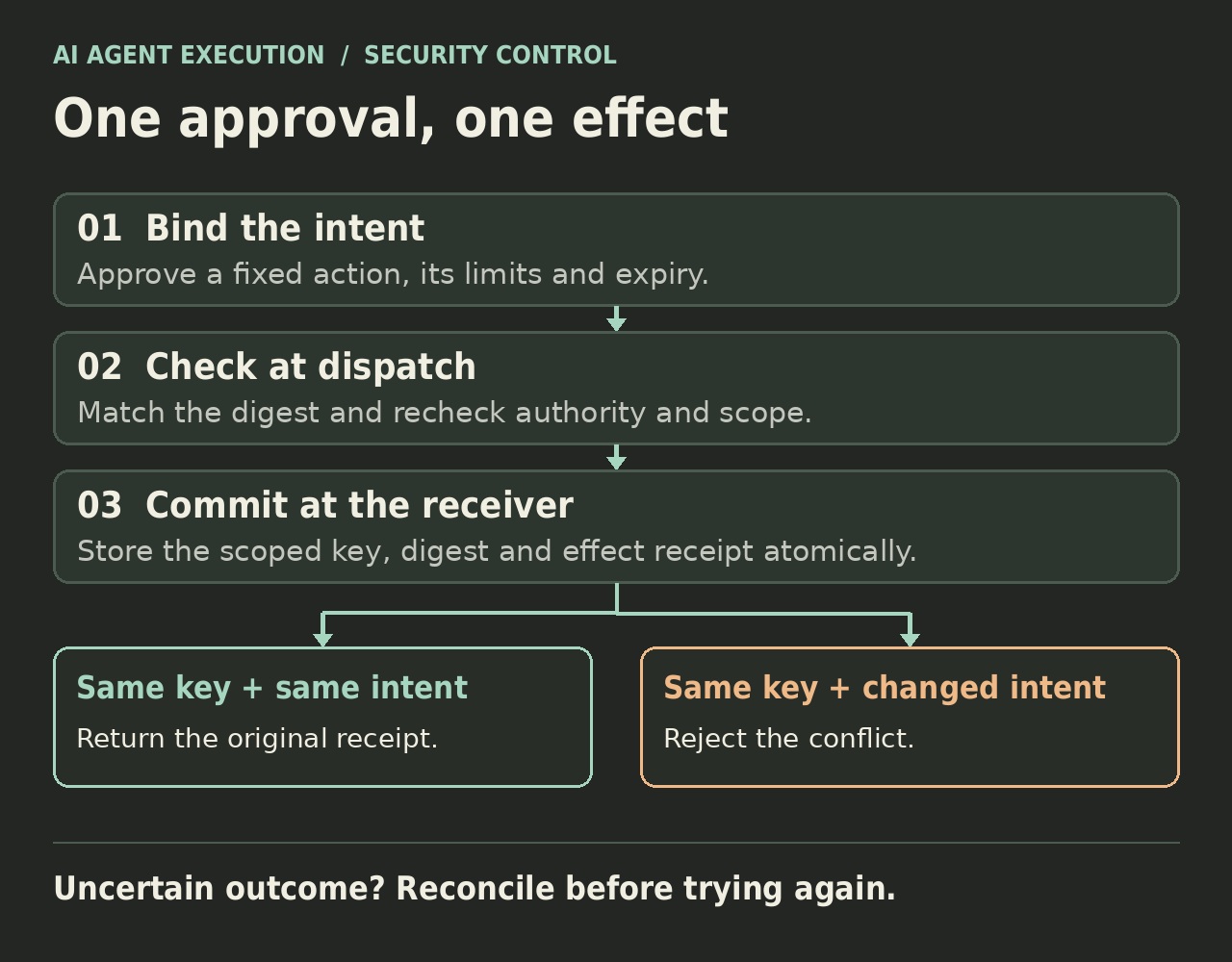
Assign one stable request key per intended effect before dispatch. Scope it to the caller and destination operation and retry with that same key and frozen intent. The receiver should record the effect and its receipt together when both share a transaction. An identical, separately authorized lookup should return the original receipt without reapplying the effect. The same scoped key with changed parameters should return a conflict, not success and not a new write. Amazon’s Builders’ Library describes this distinction and why real services have to choose how long to retain their deduplication records.
A transactional outbox commits the local intent alongside local state. It does not make an external destination idempotent. If a connector lacks a durable key and a reliable status lookup, hold an ambiguous action for reconciliation rather than automatically issuing a second request. A 202 response is evidence of acceptance, not completion; use the destination’s documented terminal state or durable record. Design the retry and reconciliation windows together. A late retry is unsafe if it can arrive after the receiver has forgotten the original key. Song Xu’s November 2026 fault-injection study tests the distinction in a controlled runtime: strict authorization and target-side deduplication alone left some runs unresolved until the runtime reconciled its ledger against destination evidence.
Four checks against an in-memory receiver
I ran a local fixture with a label update, an intent digest and an in-memory SQLite receiver. The receiver committed a fixture row and its receipt in one transaction. No model, network service, product connector or production credentials were involved. A changed label and a simulated policy denial stopped at dispatch. Discarding the first acknowledgement and resubmitting the same key and intent returned the original receipt. Presenting revised intent under that key at the receiver yielded a conflict. The effect table still contained one row.
revised intent at dispatch   -> intent_mismatch   / no dispatch
revoked execution authority -> policy_denied     / no dispatch
lost ack, unchanged request -> existing_receipt / 1 effect row
same key, revised intent    -> key_conflict     / still 1 row
The fixture demonstrates the expected contract, not durability across an actual process crash or contention across workers. In your own staging environment, kill the worker after the destination commits but before it persists the response. Restart from the real checkpoint. Verify that the destination can find the first action, then count durable effects. Repeat with an explicit denial and compare actual state, not the model’s text. Include a positive control: an unchanged, still-authorized action must finish within the promised window. Otherwise a blanket deny can pass every negative test.
Alert on disagreements between records
Log the proposal revision, decision ID, policy version, scoped execution ID, destination identity and receipt reference. Keep attempt IDs separate from effect IDs so a healthy retry doesn’t look like an incident. Don’t log tokens or full sensitive tool inputs; for low-entropy secrets, even a bare digest can leak information to someone who can guess candidates. Use redacted records or protected correlation values where needed. The useful starting alerts are a protected effect with no matching valid decision, a digest mismatch between decision and dispatch, and an eligible approval with no conclusive receipt before its deadline. Measure the last one separately from policy denials so a healthy control doesn’t get paged as a stuck queue.
Start with one consequential operation and ask its owner to show how to retrieve a receipt independently of the agent. If the only record is the agent saying it finished, the next improvement is visibility at the destination, not a nicer confirmation dialog.
💜 Enjoyed this content? Support the blog with USDT (TRC20):
TX7obcjHQbDUXb4mGqoASEu1QFTKT2CFGG