
The Regex Wrapped the Counter: GitLab CVE-2026-97229
The pipeline never started.
In this composite scenario, an exposed GitLab instance receives a CI configuration containing a regular expression. No runner claims a job. No build script executes. The server only tries to decide what the configuration means, then the Ruby process crosses a boundary its caller treated as validation: attacker-controlled pattern text reaches a native regular-expression compiler.
That is the uncomfortable shape of CVE-2026-97229. GitLab rates it critical at CVSS 10.0 and states that a specially crafted regular expression in CI/CD configuration could let an unauthenticated user execute arbitrary code on the GitLab server. Affected releases are 19.2 before 19.2.8, 19.3 before 19.3.5, and 19.4 before 19.4.2.[1][2]
The public record does not disclose the request path, complete payload, heap layout, or a reproducible product exploit. It does disclose enough to study the engineering failure: insufficient validation allowed hostile repetition syntax to reach native regex compilation, where integer overflow or wraparound could become memory corruption. GitLab’s public patches show how the defense evolved from aggregate counting to local interval limits, then tightened again when nesting kept the dangerous state reachable.[3][4]
Validation was already execution-adjacent
CI configuration is usually discussed as declarative input. That description hides the amount of computation required before a pipeline exists. GitLab evaluates rules to decide whether jobs are included, and those rules can compare values with regular expressions. The rules:exists feature also supports regex patterns for repository paths.[5]
From an operator’s perspective, this creates a valuable pre-run surface. The target does not need to schedule an attacker-controlled shell command for the configuration to matter. It must parse YAML, expand variables, evaluate conditions, normalize paths, and compile patterns. Each stage is code running inside the control plane.
The mistake is subtle because a regex often looks like data in application code:
pattern = Regexp.new(user_supplied_text)
At the native boundary, it is closer to a compact program. Quantifiers drive allocation and instruction generation. Alternation changes graph shape. Groups and nested repetitions multiply compiler work. If the compiler records lengths or repetition counts in a type that can wrap, a check such as total <= limit can become true after the arithmetic has already lost information.
MITRE describes CWE-190 as an integer overflow or wraparound that produces a value outside the intended range. The security impact depends on how that corrupted value is used. In a native parser or compiler, the dangerous sequence is familiar: calculate a size, allocate for the wrapped result, then write or emit according to the real structure.[6]
This is the same class of trust transition that appeared in the Blazor debugger code-injection flaw. There, hostile application data became generated source. Here, declarative CI text becomes input to a native compiler. Different syntax, same review question: where does supposedly passive material acquire execution semantics?
What the public patches reveal
GitLab’s first public fix adds explicit validation for range repetitions. The patch walks the pattern, accumulates repetition counts using a wider integer, and rejects counts beyond a defined threshold. Its tests cover large single ranges, consecutive ranges whose total exceeds the limit, malformed braces, escaped braces, and nested patterns.[3]
That patch is useful because it exposes the attacker’s likely search strategy without publishing an exploit. A capable operator would not begin with shell metacharacters. They would vary compiler structure:
- Find a CI field that reaches native regex compilation before authorization or pipeline execution blocks the request.
- Replace literal complexity with repetition complexity, because quantifiers influence compiled size.
- Test a single extreme interval, then several individually acceptable intervals whose aggregate crosses an arithmetic boundary.
- Introduce grouping and nesting to separate the validator’s accounting model from the compiler’s expansion model.
- Use crashes and process restarts as an oracle before attempting reliable control of memory.
The second patch matters even more. GitLab reduced the maximum permitted repetition from 1,000 to 100 and expanded tests for nested quantifiers. The merge request explains that individually bounded repetitions can still compose into a much larger effective pattern, for example when one repeated group contains another repeated element.[4]
That is the key lesson. A global budget prevents obvious aggregate abuse only if the validator measures the same cost the downstream compiler will incur. A per-node limit prevents one pathological interval, but it does not automatically constrain multiplication across nested nodes. The validator needs a cost model, not just a string scan.
GitLab also added a feature flag that disables regex support in rules:exists in the affected patch line. That is a containment decision as much as a parser fix: remove an exposed route to the compiler while strengthening validation around the remaining routes.[3]
A safe integer-wrap mechanism lab
The following lab is not GitLab, Ruby, Onigmo, or a CVE exploit. It models a narrow property visible in the public remediation: an aggregate repetition counter can wrap, and permissive per-interval limits can remain unsafe under nesting. It opens no listener, targets no product, and uses a 16-bit counter so the failure is observable with small numbers.
MASK16 = 0xFFFF
AGGREGATE_LIMIT = 50_000


def wrapped_total(intervals):
    total = 0
    for count in intervals:
        total = (total + count) & MASK16
    return total


def vulnerable_accepts(intervals):
    return wrapped_total(intervals) <= AGGREGATE_LIMIT


def fixed_accepts(intervals, per_interval_limit):
    if any(count > per_interval_limit for count in intervals):
        return False
    return sum(intervals) <= AGGREGATE_LIMIT


case = [60_000, 10_000]
assert sum(case) == 70_000
assert wrapped_total(case) == 4_464
assert vulnerable_accepts(case) is True
assert fixed_accepts(case, 1_000) is False

outer, inner = 500, 500
assert outer * inner == 250_000
assert outer <= 1_000 and inner <= 1_000
assert not (outer <= 100 and inner <= 100)
I executed the lab for this analysis. The assertions returned:
EXACT_TOTAL=70000
WRAPPED_UINT16_TOTAL=4464
AGGREGATE_ONLY_ACCEPTED=True
WIDE_PLUS_1000_CAP_ACCEPTED=False
NESTED_500_X_500_EXPANSION=250000
NESTED_PASSES_1000_PER_INTERVAL=True
NESTED_PASSES_100_PER_INTERVAL=False
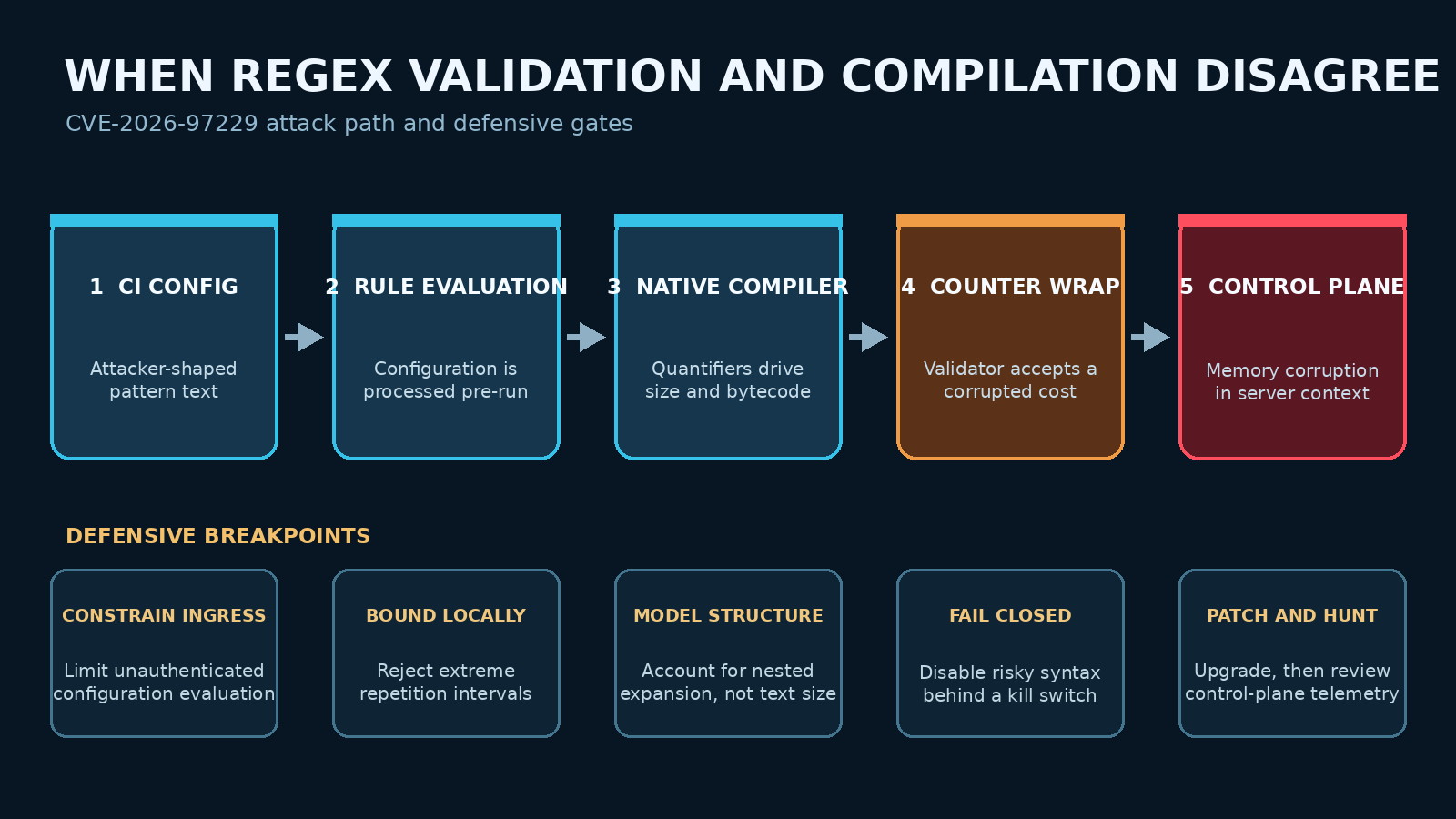
The model deliberately stops before memory corruption. Its value is in showing why three controls are distinct: use arithmetic that cannot silently wrap at the expected scale, reject extreme local intervals, and account for structural multiplication. Real regex engines have more dimensions than this toy model, including bytecode size, capture bookkeeping, branches, recursion, encoding, and optimization passes.
Reconstructing the attack chain without inventing it
The confirmed chain starts with an unauthenticated user and a crafted regex in CI/CD configuration, then ends with arbitrary code in the GitLab server context.[1][2] The undisclosed middle should remain undisclosed in analysis rather than filled with a plausible endpoint.
A defensible model has four stages:
Ingress. Attacker-controlled CI configuration reaches server-side validation. The exact public request sequence is not documented.
Compilation. A regex-bearing rule is converted into a native regular expression. No runner-side execution is required for this stage.
Compiler corruption. Repetition structure defeats or exceeds the caller’s validation model, reaching an integer-wrap condition in native compilation. The public patches strongly support this mechanism, but they do not publish a weaponized layout.[3][4]
Control-plane impact. Successful exploitation executes in the GitLab application context. From there, impact can extend to repositories, CI variables, integration secrets, tokens, artifacts, package registries, and downstream deployment trust, depending on local configuration and segmentation.
This control-plane emphasis is important. The Nuclei template trust analysis showed how a security tool can become the asset under attack. CVE-2026-97229 applies the same inversion to DevSecOps infrastructure: the system evaluating whether code may run is compromised during evaluation.
Detection and response
GitLab says it found no evidence of exploitation and recommends immediate upgrade to 19.2.8, 19.3.5, or 19.4.2. GitLab.com and GitLab Dedicated had already been patched when the advisory was published.[1]
For self-managed environments, patching is the first control, not the end of the investigation. Review:
- GitLab application crashes, OOM events, worker restarts, and abnormal native faults during CI configuration validation;
- repeated submissions of CI configurations with dense brace quantifiers, nested groups, or unusual regex-heavy
rulessections; - requests that trigger CI linting or pipeline creation but never produce a normal pipeline lifecycle;
- unexpected child processes, outbound connections, file changes, or token use from GitLab application nodes;
- access to CI variables, project tokens, runners, package credentials, and deployment integrations following a suspicious application event.
A WAF rule that blocks large braces is fragile. The patch history itself shows why: structural composition matters more than one obvious number. Detection should combine regex complexity signals with the server-side action that compiles them and the endpoint behavior that follows.
Treat a suspected successful exploit as control-plane compromise. Isolate affected nodes, preserve application and system telemetry, rotate instance and integration secrets, review administrator and token activity, validate runner registration, and check downstream release systems. Rebuilding only the web node while preserving stolen credentials leaves the attacker on the trusted side of the pipeline.
The parser differential behind http4s request desynchronization offers a useful defensive analogy. There, two HTTP components disagreed about message boundaries. Here, the validator and regex compiler can disagree about computational size. Security depends on both components enforcing the same model.
Strategic takeaways
CVE-2026-97229 is not mainly a story about an exotic regex. It is a warning about pre-execution interpreters inside development platforms. CI linters, template renderers, policy evaluators, expression engines, regex compilers, diff parsers, and preview generators all process attacker-shaped structure before the organization thinks it has authorized execution.
Review these surfaces with native-code assumptions. Identify every field that reaches a parser or compiler, the arithmetic used for lengths and costs, how nesting changes expansion, and which principal owns the process. Then provide a kill switch for high-risk syntax. GitLab’s feature flag for rules:exists regex is a practical example of reducing exposure while a deeper fix settles.
The pipeline never needed to run because the control plane had already done enough. It accepted a compact language from an untrusted source, estimated its cost incorrectly, and handed it to native code. For security teams, the durable question is not only what a configuration author can execute. It is what the platform executes while trying to understand the configuration.
Sources
- GitLab 19.4.2 critical patch release (published October 15, 2026)
- CVE-2026-97229 record (published October 13 and updated October 14, 2026)
- GitLab MR 220695: validate range repetition in regex (public patch reviewed October 19, 2026)
- GitLab MR 220697: limit permissive intervals (public patch reviewed October 19, 2026)
- GitLab CI job rules documentation (accessed October 19, 2026)
- MITRE CWE-190: Integer Overflow or Wraparound (accessed October 19, 2026)
💜 Enjoyed this content? Support the blog with USDT (TRC20):
TX7obcjHQbDUXb4mGqoASEu1QFTKT2CFGG